When I was in college, I worked as a machine integrator, facing
real‑world
challenges that no textbook fully prepares you for.
Risk assessments, safety circuits, audits — I lived all of it on the shop floor.
That’s why I pursued the CMSE® – Certified Machinery Safety Expert (TÜV NORD)
certification.
And let me tell you: it’s not just a title.It’s a confirmation that you truly understand
machinery safety at a deep, professional level.
A solid foundation
Before opening a single standard, I already had:
- 2 years integrating systems
- troubleshooting PLCs
- validating safety functions
- and working directly with operators and maintenance teams
This background helped me understand the “why” behind every requirement — and it also made
me
realize that,
back then, we weren’t always following the best safety practices. We did what we could with
the
knowledge we had,
but CMSE gave me the framework to understand how things should be done and why
Diving Into the Standards
Preparing for CMSE meant truly understanding the standards that shape
modern machinery safety:
- ISO 13849-1/-2
- IEC 61508
- ISO 12100 — the chairman, frontman, the one and only go‑to risk
assessment standard before anything else
- The 2006/42/ECMachinery Directive
- And many related standards
At first, the overlap between them can feel overwhelming.But once you understand the logic
behind each one — their scope,
their intent, and how they complement each other — everything starts to make sense.
You begin to see the structure behind the complexity, and that’s when the real learning
happens.
My Study Strategy (The Real Deal)
My CMSE Manual — The Most Annotated Book I Own
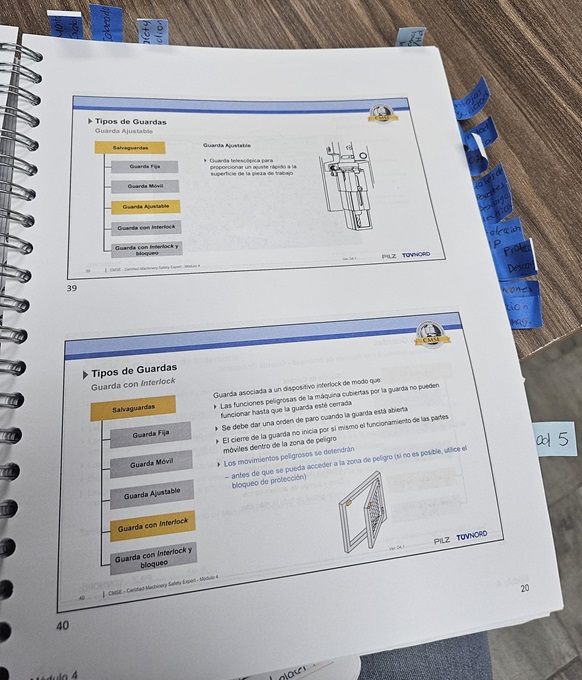
I treated the manual like a working tool:
- Post‑its for quick navigation
- Cross‑references between standards
- and markers for sections I knew would matter in the exam.
My Notebook — Where Theory Met Practice
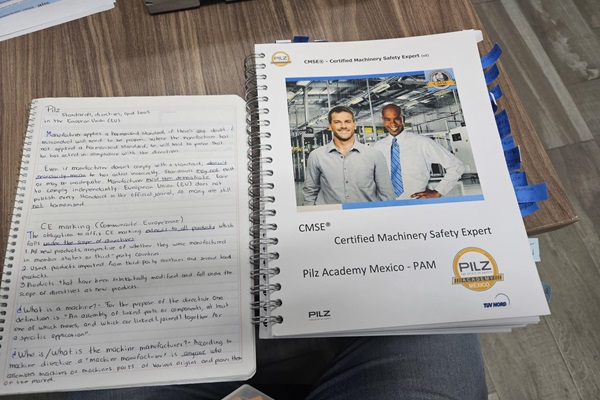
Writing by hand helped me connect the training material with real‑world
scenarios.
The whole thing isn’t about “knowing everything” — that’s impossible.
Even on the shop floor, you don’t need every period and comma memorized.
You need to understand, and you need to know what to look for and where to find it so
you
can fine‑tune your decisions.
The 4-Day training
The Pilz training is dense:
- 8 hours per day
- Over 1,000 slides
- Deep dives into functional safety
- Case studies that mirror real industrial problems
Not gonna lie — there were moments when my eyes got heavy.
Staying focused was a constant challenge.
The struggle is real.
But every slide matters, and everything eventually clicks.
The Exam
The exam is:
- open‑book
- 1 hour long
- and designed to test your reasoning, not your memory.
If you don’t understand the standards, the manual won’t save you.
After submitting the exam, you wait 3–4 weeks for a simple “pass / no pass”.
No feedback. No breakdown.
And let me tell you something: when I was there, at least 10 people were taking it for the
second time.
It is a hard test.
Why This Certification Matters to Me
For two years, I worked as an integrator making decisions that directly impacted
people’s
safety.
I always took that responsibility seriously.
Becoming a CMSE is more than a credential — it’s a formal recognition that:
- I understand machinery safety at an expert level
- I can justify my decisions with solid technical criteria
- and I’m prepared to design, evaluate, and validate safety systems with confidence.
Final Thoughts
If you’re considering the CMSE certification, especially if you already work in machine
safety,
I can tell you this: It’s worth it.
It validates your experience, sharpens your judgment, and gives you a framework to back
up every decision you make.
And if you need advice or want to know more about the process, feel free to reach out.
I’m always happy to help fellow engineers grow in this field.